Partners In Learning Blog Team

Partners In Learning Blog Team
Blog Team

Wednesday, November 7, 2012

Multicltural in the Classroom!

What is a multicultural classroom? A multicultural classroom is one in which both the students and the teacher are accepting of all races, cultures, and religions. This acceptance is evidenced by the books that are read, the activities that are completed, and the lessons that are taught.
 
This week in the classroom we are learning about foods from around the world. Monday we talked about food we eat every day. Then Tuesday we talked about food we do not eat every day, and we had a parent come in from The New China One that made us noodles!
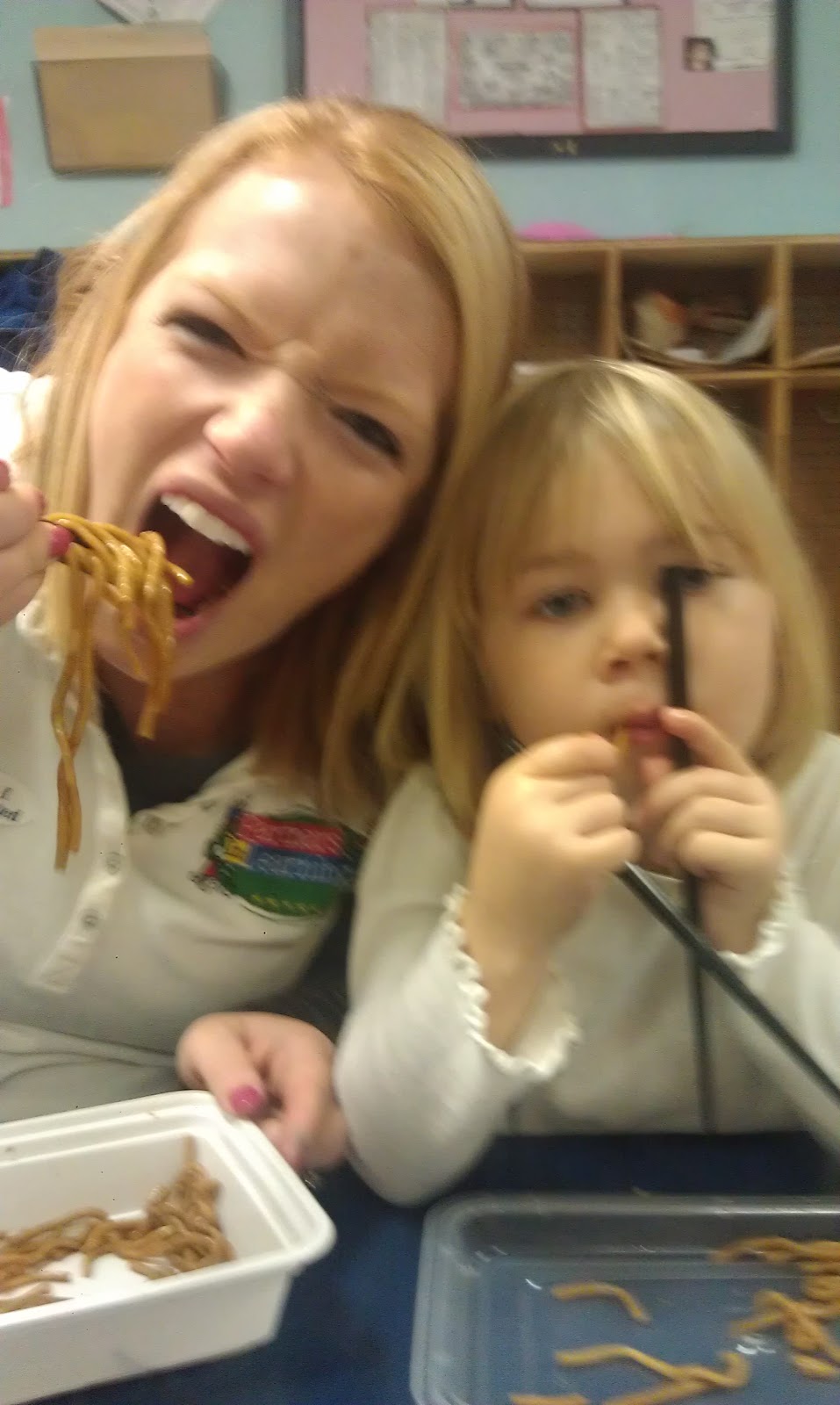
Showing the children how to use Chopsticks!!


Having fun trying to use the chopsticks! (Doing a great job)
The children learned so much by doing this activity, we learned about food from around the world along with using our fine motor skill with the chopsticks.
 
Why is multiculturalism so important? Multiculturalism is important because the world is changing every day. We must learn to accept and get along with all cultures, races, and religions in order to become productive citizens of the world.


Being Silly, Pre-k Teacher, Amanda Marshall

Tuesday, November 6, 2012

THINGS I LEARNED WHILE HANGING OUT WITH MY FRIENDS (WHO HAPPEN TO HAVE AUTISM)

Salisbury Autism Support Group at Ryan's Restaurant on Nov. 3

Last Saturday morning, I joined friends for a casual breakfast here in Salisbury.  It was an occasion for our Salisbury Autism Support Group to come together, enjoy each other’s company, exchange information and share our success stories.  Here are a few things I learned:
• Khalil likes to run off his meal immediately after he’s finished eating
• CJ is a food stealer

• Parents report that this academic year is getting off to a fairly good start

• If CJ has Jell-O, then it’s almost certain that Robbie will have to have Jell-O too

• Three months ago, Khalil wouldn’t say a word to me. He’s talking to everybody now----including me!

• If CJ gets bored-----no problem---He’ll just borrow his mother’s phone and play a game or two

This is a great group of people----awesome individuals----wonderful, loving families.  I encourage you to join us some time.  Actually, we’re planning to do breakfast again sometime soon.

Katherine Generaux, Community Inclusion


Monday, November 5, 2012

That's What Friends Are For...


I get by with a little help from my friends. John Lennon


Doing favors for friends such as babysitting while mom or dad goes to school, work, etc. is priceless. Having a support network helps you get by! Everyone needs help. When someone is in need of something in any situation; think of something appropriate and do it!


Madison, 6, enjoyed helping Eden eat dinner! Eden had to give in and stop feeding herself because Madison wanted to be a big helper and spoon feed her! Allow your children to participate in being helpful to others by following your example.


I was honored to babysit Miss Eden. Why? Because when I was attending night school, someone did it for me! Does this mean Amanda owe's me a favor? No! Why? Because...... THAT'S WHAT FRIENDS ARE FOR!


When was the last time you helped a friend? Make it a point to do something for someone this week. Will you accept my challenge?


Michelle Macon, Program Coordinator

Saturday, November 3, 2012

What does music have to do with it?

Some people may be thinking; What does music have to do with learning?".  That is an easy question to answer!  There is a direct connection between music and the development of mathematical thinking. Mathematical concepts are developed as children sing counting songs.  Music can create an imaginary world that stimulates a child’s creativity.  Music also seems to be related to very primal parts of the brain (Hudson 2011). Our bodies cannot help but react physiologically to musical input (Thaut & Kenyon 2003; Hasan & Thaut 2004). This implies that even the youngest children have the potential to inherently respond to music and the mathematical constructs it contains.  In the video below, you will see one of our NCPreK teachers (Mr. Matt) playing his guitar and singing with the children.  This is one the highlights of their day.  They have so much fun and joy and do not even know they are actually learning.


Music is a highly social, natural, and developmentally appropriate way to engage even the youngest child
in math learning.  NAEYC

Norma Honeycutt, Executive Director

Thursday, November 1, 2012

Using Visual Aids and Songs to Teach Hand Washing

As the colder weather approaches, so does the threat of common colds and other yucky sicknesses for our children.

The most effective way to prevent getting sick this season is to wash hands, therefore we need to teach our children the proper hand washing techniques.


Washing hands isn't only for after using the bathroom, below are the appropriate times to wash your hands throughout the day.

- before and after meals
- before and after treating a cut or wound
- after cleaning up the bathroom or lunch table
- after blowing your (or a child's) nose, coughing, sneezing
- after petting an animal or pet food
- after touching garbage


The proper technique involves (1) wetting your hands, (2) apply soap and lather, (3) continue rubbing for at least 20 seconds (Sing the "Happy Birthday" song twice to equal appropriate time), (4) rinse your hands well, (5) dry hands with a clean towel


While it is fairly easy to teach these techniques, some children may have difficulty with the proper procedure. Children with special needs may have trouble following the steps to handwashing, which is important for all children to master.


Visual aids, handwashing songs, and modeling are great ways to help children who need a little extra assistance.


Katherine Zink, ITFS/P